
What happened#
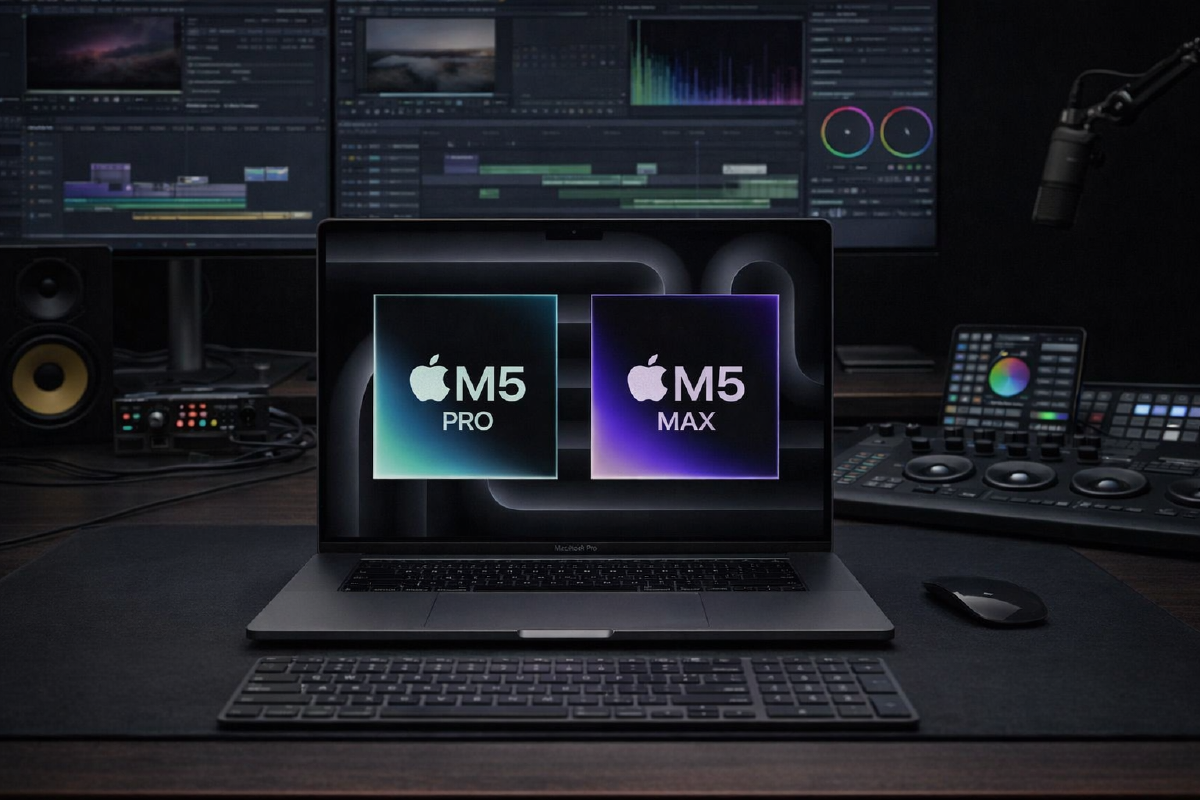
Apple announced the MacBook Pro with M5 Pro and M5 Max chips on March 3, 2026, with pre-orders opening March 4 and general availability beginning March 11. The M5 Max represents a significant architectural shift from the M4 Max, moving from a 16-core CPU to an 18-core design featuring six “super cores” and 12 efficiency-focused performance cores. The M4 Max used a 14-core to 16-core design depending on configuration.
The GPU scales up to 40 cores on the M5 Max, while the M5 Pro maxes out at a lower core count. Memory bandwidth sees substantial improvements: the M5 Pro supports up to 64GB of unified memory with 307GB/s bandwidth, while the M5 Max retains the 128GB maximum capacity but increases bandwidth to 614GB/s. Apple claims CPU performance improvements of up to 30 percent for pro workloads compared to the M4 generation.
Key details#
| Detail | M5 Max | M4 Max |
|---|---|---|
| CPU cores | 18 (6 super + 12 performance) | 14-16 cores |
| GPU cores (max) | 40 | Lower (exact count varies) |
| Unified memory (max) | 128GB | 128GB |
| Memory bandwidth | 614GB/s | Lower (exact figure not specified) |
| CPU performance gain | Up to 30% vs M4 | Baseline |
| Announcement date | March 3, 2026 | 2024 |
| Availability | March 11, 2026 | 2024 |
M5 Pro specifications:
- 18-core CPU (6 super + 12 performance)
- Up to 64GB unified memory
- 307GB/s memory bandwidth
Why it matters for developers#
The 18-core CPU architecture represents Apple’s most significant core count increase in a single generation for the Max series. The addition of six “super cores” alongside 12 efficiency-focused performance cores suggests a three-tier performance hierarchy rather than the traditional high-performance/efficiency split. For compilation tasks, video encoding, and parallel workloads, the 30 percent performance improvement could translate to meaningfully faster build times and rendering.
Memory bandwidth improvements matter for machine learning workflows and large dataset processing. The M5 Max’s 614GB/s bandwidth provides faster access to the unified memory pool, which remains capped at 128GB—the same as M4 Max. Developers working with LLMs, high-resolution video editing, or complex 3D rendering will benefit from faster data transfer between CPU, GPU, and memory.
The question of upgrade value depends heavily on current hardware. M4 Max users face a decision between a 30 percent performance gain and the cost of a full system replacement. For those on M1 or M2 Max systems, the cumulative improvements across three generations make the upgrade more compelling. The unchanged 128GB memory ceiling means developers already constrained by RAM won’t find relief in the M5 Max.
Availability and pricing#
The MacBook Pro with M5 Pro and M5 Max became available for pre-order on March 4, 2026, with general availability starting March 11, 2026. Pricing has not been officially announced in the available sources.
What to watch next#
Independent benchmarks from sources like Geekbench, Cinebench, and real-world compilation tests will clarify whether the 18-core architecture delivers consistent 30 percent gains across diverse workloads or if improvements concentrate in specific scenarios. The performance characteristics of the six “super cores” versus the 12 efficiency-focused cores remain unclear—testing will reveal whether this three-tier design offers advantages over traditional performance/efficiency splits for developer workflows.